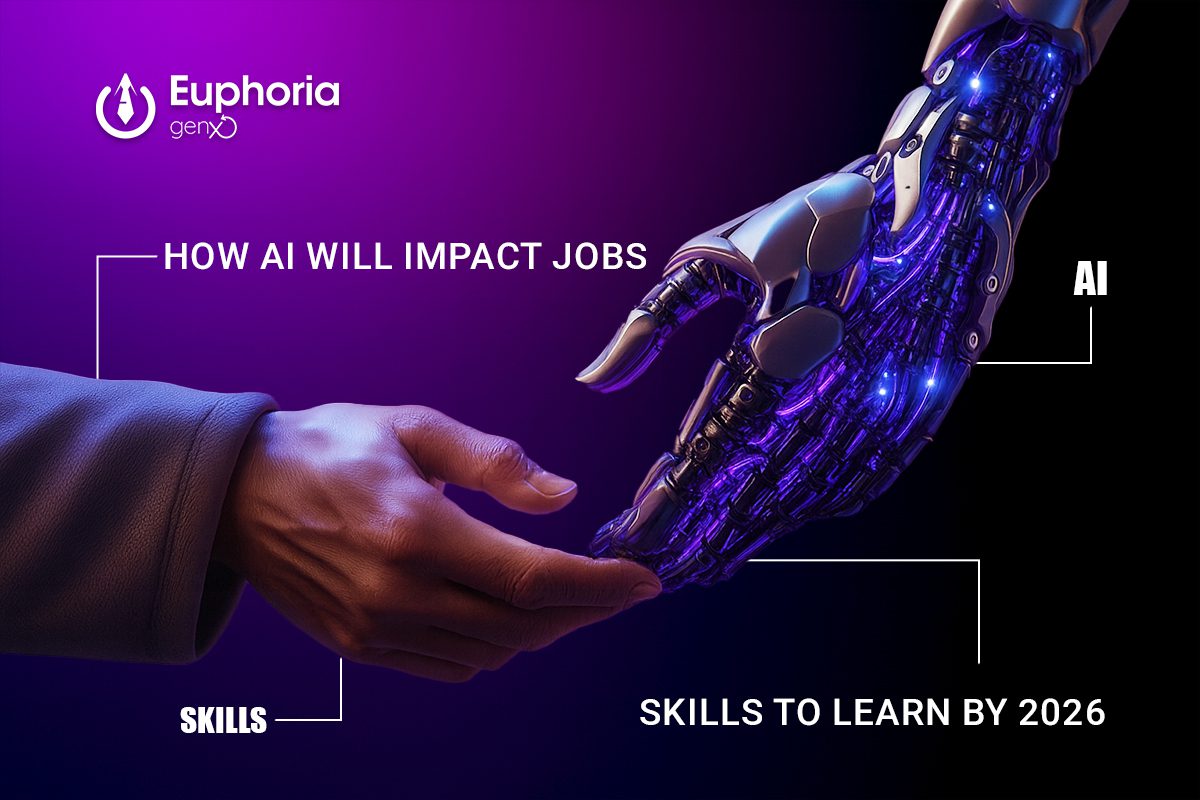
The impact of AI on jobs is already reshaping the global workforce. Artificial Intelligence (AI) is no longer a futuristic concept—it is actively transforming industries, redefining job roles, and changing how businesses operate worldwide. From automation in manufacturing to intelligent decision-making in finance and healthcare, AI has become deeply embedded in modern workflows. As we move closer to 2026, professionals, students, and job seekers are asking one crucial question: What skills will ensure career stability and growth in an AI-driven world?
This blog explores how AI is impacting jobs, which roles are evolving or emerging, and the essential skills you must develop to remain relevant, competitive, and job-ready by 2026.
The impact of AI on jobs is becoming increasingly evident across industries. AI refers to systems and machines capable of performing tasks that traditionally require human intelligence—such as learning, reasoning, problem-solving, and decision-making. Over the last decade, advancements in machine learning, data analytics, natural language processing, and automation have accelerated AI adoption across industries, directly transforming job roles and workplace requirements. According to industry reports, AI-related roles are expected to grow by over 40% by 2026, highlighting the rapid expansion of AI-driven opportunities. Additionally, more than 70% of employers now prioritize skills over degrees, signaling a major shift toward skill-based hiring in the modern job market.
The impact of AI on jobs is not about elimination, but transformation. AI is not simply replacing jobs—it is redefining them. Repetitive and rule-based tasks are increasingly automated, allowing professionals to focus on more strategic, creative, and human-centric responsibilities. As a result, job roles across industries are evolving, requiring new skill sets and greater adaptability. For example:
While some roles may decline, many new opportunities are being created, particularly in technology-driven domains.
Certain job roles that rely heavily on repetitive processes or basic analysis face a higher risk of automation, including:
However, this does not mean these professionals will become obsolete. Instead, they will need to reskill or upskill to transition into more advanced roles.
AI is also creating entirely new job categories and transforming existing ones. Some of the most in-demand roles by 2026 include:
The demand for IT jobs that combine technical expertise with problem-solving and adaptability is growing rapidly.
The impact of AI on jobs has significantly shifted employer expectations. In the AI-driven job market, skills now outweigh traditional qualifications, with employers increasingly prioritizing practical expertise, hands-on experience, and adaptability over theoretical knowledge alone.
Companies now seek professionals who can:
This shift has led to a strong demand for job-oriented training programs that focus on real-world applications rather than purely academic learning.
To thrive in the AI era, professionals must develop a balanced combination of technical and soft skills.
AI systems rely on data. Understanding how to collect, analyze, interpret, and visualize data is critical across roles—not just for data scientists. Professionals who can make data-driven decisions will always be in demand.
Key areas to focus on:
You don’t need to become an AI engineer, but understanding how AI works is essential. Familiarity with machine learning concepts, automation logic, and AI applications helps professionals collaborate effectively with technical teams and use AI tools efficiently.
Coding skills are becoming a foundational requirement for many IT jobs. Languages commonly used in AI and automation include Python, Java, and JavaScript. Automation skills help professionals streamline workflows and improve productivity.
Most AI applications run on cloud infrastructure. Knowledge of cloud platforms, deployment models, and cloud security is a major advantage. Cloud skills also support scalability and innovation in AI-powered systems.
As AI adoption increases, so do cybersecurity risks. Understanding data privacy, ethical AI usage, and security fundamentals is essential, especially for professionals handling sensitive data.
While AI excels at processing information, it cannot replicate uniquely human qualities. These soft skills will remain irreplaceable.
AI can provide insights, but humans must interpret them. Professionals who can evaluate AI outputs, question assumptions, and solve complex problems will stand out.
AI can generate ideas, but creativity comes from human imagination. Design thinking, innovation, and storytelling skills are highly valuable in marketing, product development, and leadership roles.
Human interaction, empathy, negotiation, and leadership cannot be automated. Strong communication skills are essential for teamwork, client interactions, and people management.
The AI landscape evolves rapidly. Professionals who continuously learn, reskill, and adapt will remain relevant, regardless of technological changes.
Becoming job-ready by 2026 requires a strategic approach to learning and career development.
Hands-on projects, real-world case studies, and industry exposure are crucial. Employers value candidates who can demonstrate applied skills rather than just certifications.
This is where job-oriented training plays a critical role by bridging the gap between academic knowledge and industry expectations.
Select learning programs that align with current market needs—AI, data analytics, cloud computing, cybersecurity, and full-stack development are among the top domains driving IT jobs growth.
A portfolio showcasing real projects, problem-solving approaches, and measurable outcomes significantly improves employability. It proves your ability to apply skills in practical scenarios.
Internships, live projects, and simulated industry environments help learners understand real workplace challenges. Such experiences accelerate confidence and career readiness.
Educational institutions and organizations must evolve alongside technology. Structured job-oriented training programs, industry mentorship, and continuous upskilling initiatives are essential for building a future-ready workforce.
Employers are also investing in reskilling existing employees rather than replacing them, recognizing that adaptability and learning potential are more valuable than static skill sets.
AI will not eliminate jobs—it will redefine them. Professionals who proactively prepare for this shift will enjoy greater career stability, growth opportunities, and global relevance.
By focusing on both technical expertise and human-centric skills, individuals can position themselves as indispensable assets in an AI-powered economy. Those who invest in learning today will lead tomorrow.
The impact of AI on jobs is undeniable, but the real differentiator lies in how prepared you are to adapt and grow. By 2026, success in the workforce will depend on a strong blend of technical expertise, human-centric skills, and real-world exposure. Degrees alone will no longer define employability—practical knowledge, adaptability, and continuous learning will.
To stay ahead in this evolving landscape, choosing the right learning partner is crucial. Enrolling in the best IT training institute that focuses on industry-aligned curriculum, hands-on projects, and placement-oriented learning can significantly accelerate your career growth. Institutes that emphasize real-time projects, mentorship, and career guidance help learners transition smoothly into IT jobs and become truly job-ready.
AI is a powerful tool, but it is your skills, mindset, and training that determine how effectively you can use it. Invest in the right learning path today, and you’ll be well-equipped to thrive in the AI-driven future of work.
































© 2026 Euphoria GenX. All Rights Reserved. UDYAM-WB-10-0197721 MSME